
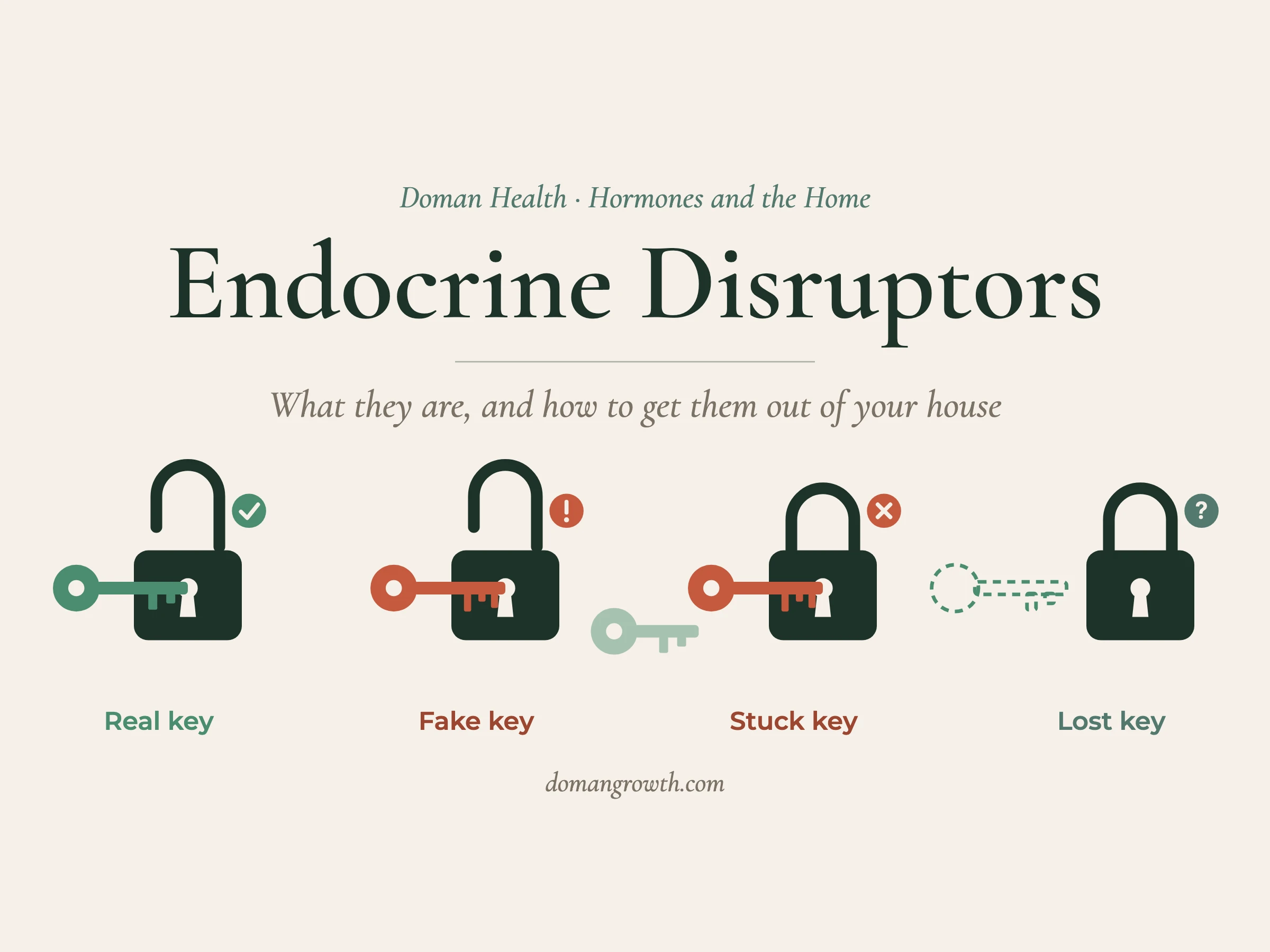
What is an endocrine disruptor
You hear the term on the news. You hear it from friends who care about their health. Most people nod along, but very few can explain it.
The short answer: an endocrine disruptor is a chemical that messes with your hormones. Hormones are your body’s messengers. These chemicals come from everyday products, and they get in the way of those messages. The National Institute of Environmental Health Sciences says they can copy your hormones, block them, or interfere with them.
I grew up in a family that has cared about this for decades, and I’ve spent years dialing in my own health. This is the plain version I’d give a friend.
How hormones work
Your body has glands, like your thyroid. They send hormones out through your blood. Hormones tell your body when to grow, when to burn energy, when to sleep and when to mature.
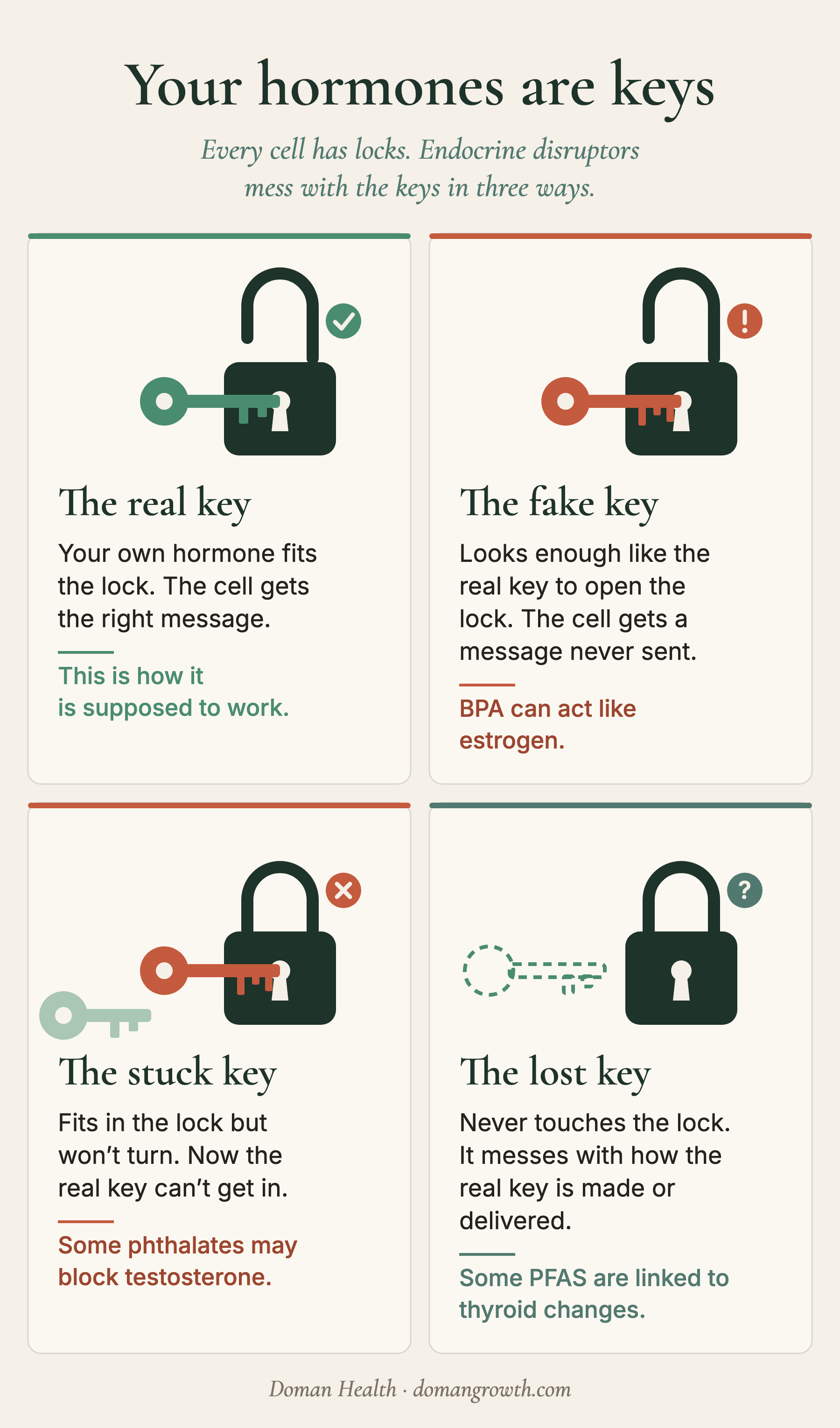
Think of a hormone as a key. Every cell has locks. When the right key goes into the right lock, the cell gets the message and does its job.
Your body only needs a tiny amount of a hormone to send a message. That’s why even a small amount of the wrong chemical can cause problems. Endocrine disruptors cause trouble in three ways.
- The fake keyIt looks enough like the real key to open the lock. The cell gets a message your body never sent. Example: BPA can act like estrogen.
- The stuck keyIt fits in the lock but won’t turn. Now the real key can’t get in. Example: research points to some phthalates blocking testosterone.
- The lost keyIt never touches the lock. It messes with how your body makes or delivers the real key, so the key never shows up. Example: research has linked some PFAS to changes in thyroid hormone.
Why this matters for everyone
Hormones do a lot more than drive growth. In adults they control your energy, your metabolism, your sleep, your mood and your fertility. If the messages get scrambled, all of that can feel it.
Research has linked some endocrine disruptors in adults to changes in thyroid function, blood sugar and weight, and reproductive health. Some researchers call certain of these chemicals obesogens, because they may push the body toward storing fat. If you’re doing the work on food, sleep and training, this is one more lever you can pull.
If you’re a parent, or planning to be
With most toxins, more is worse. Hormones work differently. When you’re exposed can matter as much as how much.
Some stages of life are extra sensitive: pregnancy, babies, young kids and puberty. During these years the body is being built, and hormones are the instructions. A wrong message during building does more damage than the same message later in life.
Kids also get a bigger dose for their size. They eat, drink and breathe more for their body weight than adults do. They crawl on floors where dust collects. They put everything in their mouths.
Almost everyone is exposed
- More than 90% of Americans have BPA in their urine (Journalist’s Resource).
- At least 99% of Americans have PFAS in their blood (Pew).
- About 85,000 man-made chemicals are in use. 1,000 or more of them may be endocrine disruptors (NIEHS).
Small changes work fast
Most of these chemicals leave your body within hours to days. When you cut back, your levels drop quickly.
- Fresh food for three days. In a 2011 study, families ate fresh food that didn’t come in cans or plastic. Their BPA dropped 66%. A common phthalate dropped by about half.
- New shampoo and lotion for three days. In the HERMOSA study, 100 teenage girls switched to products without phthalates, parabens and similar chemicals. Two common parabens dropped about 45%.
PFAS are the exception. They can stay in your body for years. That’s why avoiding new PFAS exposure matters so much.
The worst offenders
If you only focus on two, make it PFAS and phthalates. PFAS stay in your body for years. Phthalates are in so many daily products that you’re exposed all day long. BPA is a close third.
| Chemical | Where you find it | Why it matters |
|---|---|---|
| PFAS (“forever chemicals”) | Nonstick pans, stain-proof and waterproof fabric, greasy food wrappers, microwave popcorn bags, some tap water | Takes years to leave your body. Linked to thyroid, cholesterol and immune changes. |
| Phthalates | Products that list “fragrance,” soft vinyl plastic, food packaging | May block testosterone. The biggest concern is during pregnancy. |
| BPA and its cousins | Can linings, hard clear plastic, paper receipts | Acts like estrogen. “BPA-free” often means a similar chemical was swapped in. |
| Parabens | Lotions, shampoos, makeup | Preservatives that act a little like estrogen. They soak in through your skin. |
| Flame retardants | Older couches and carpet padding, electronics, house dust | They settle in dust. Linked to thyroid and brain development. Kids on the floor get the most. |
| Some pesticides | Non-organic produce, lawn sprays | Some are linked to brain development problems in kids. |
| Oxybenzone | Chemical sunscreens | Soaks in through your skin and is being studied for hormone effects. |
The EPA limits two PFAS in drinking water to 4 parts per trillion. Water systems have until 2029 to meet that limit, and as of 2026 the EPA has proposed pushing that to 2031.
Most of these get in through what touches your food, what you put on your skin, and the dust in your house. Fix those and you’ve covered most of it.
Easy swaps, room by room
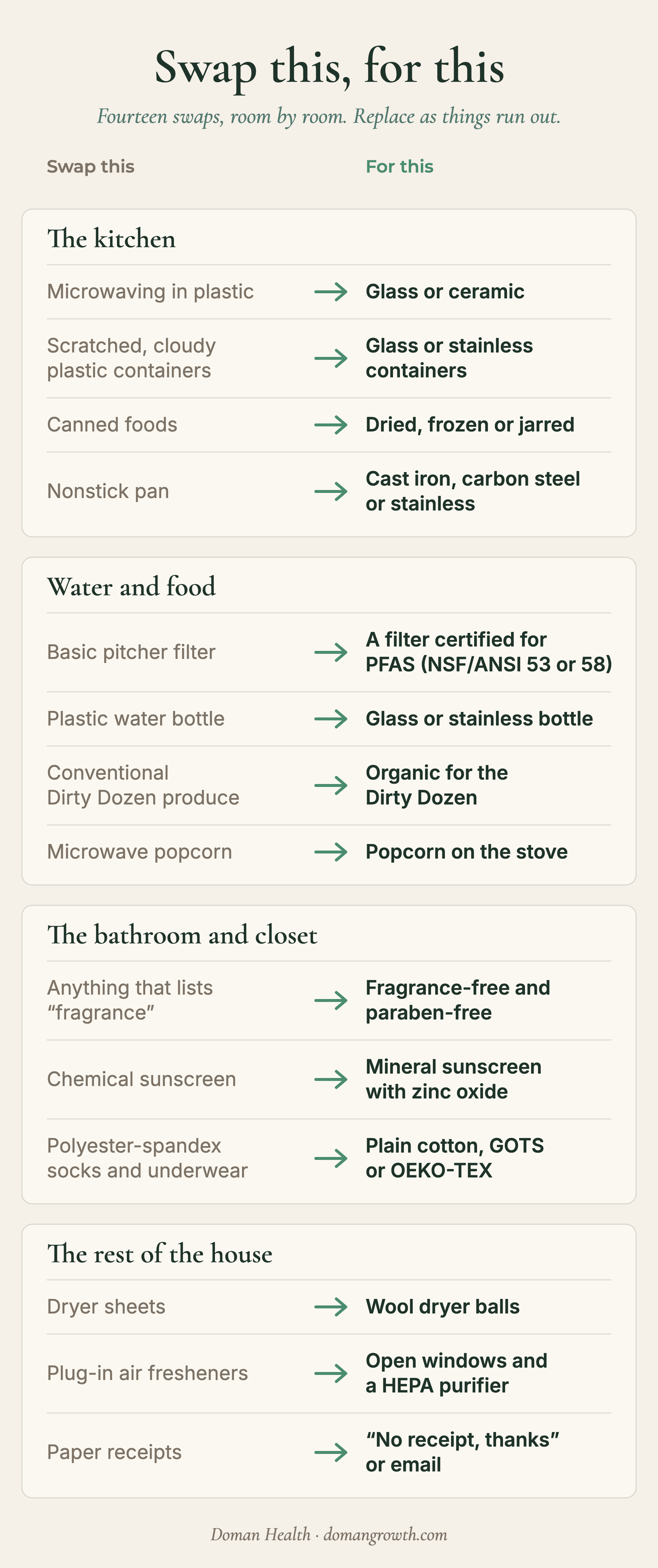
You don’t have to throw everything out. Replace things as they run out. Start with whatever touches your food and your skin every day.
A few tips first, then the full list.
- Heat makes it worse. Hot food pulls more chemicals out of plastic. Never microwave in plastic. Use glass or ceramic.
- “BPA-free” isn’t enough. It often means a similar chemical took BPA’s place. Glass and stainless steel are the safer bet.
- Skip “fragrance.” That one word on a label can hide dozens of ingredients, often including phthalates. Buy “fragrance-free.” “Unscented” isn’t always the same thing, so check the label.
- Get the right water filter. Basic pitcher filters may not remove PFAS. Look for reverse osmosis, or a filter certified for PFAS under NSF/ANSI 53 or 58.
- Buy organic where it counts. Use the Environmental Working Group’s Dirty Dozen list to pick which produce to buy organic. Wash everything.
- Clean up the dust. Chemicals settle in house dust. Wipe with a damp cloth and use a HEPA vacuum, especially where kids play.
- Watch what you wear. Underwear, socks and pajamas sit against your skin for hours, warm and damp. Testing by the Center for Environmental Health has found BPA in polyester-spandex clothing, including baby socks. Independent testing has also found PFAS in some period underwear. Choose plain cotton, ideally certified organic (GOTS) or OEKO-TEX Standard 100. Skip labels like moisture-wicking, odor-control and antimicrobial, which usually mean a chemical treatment. Wash new clothes before anyone wears them. Start with the kids, since they sleep in this stuff.
The four-week plan
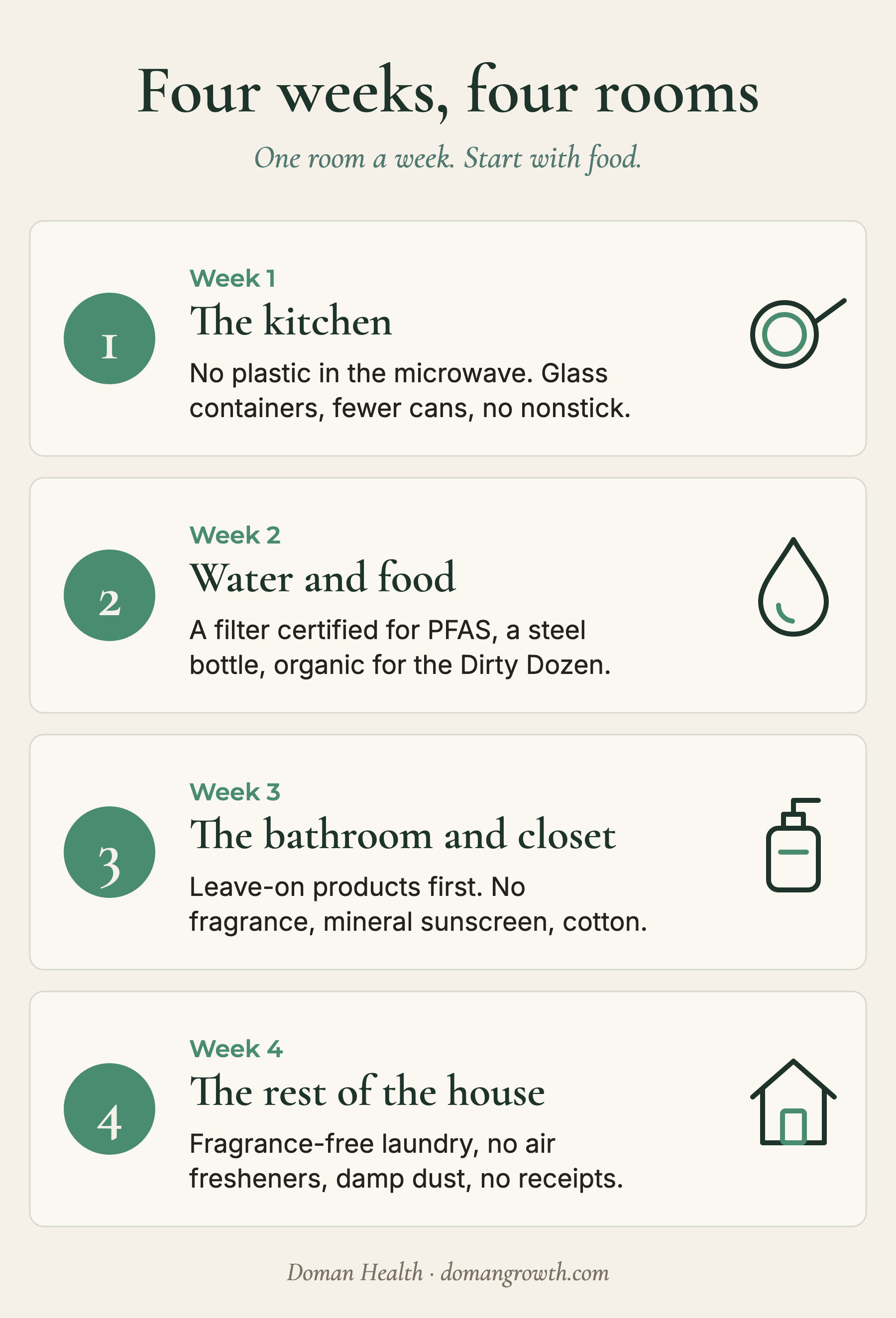
One room a week. Start with food, because food packaging is the biggest source of BPA and phthalates. Then the bathroom, then the rest of the house.
Check things off as you go. Your progress saves on this device.
Week 1: The kitchen
Week 2: Water and food
Week 3: The bathroom and closet
Week 4: The rest of the house
Zoom out
Nobody gets to zero. These chemicals are in our air, water and food. The goal is to lower the amount, especially during pregnancy, with young kids, and in the things you use every day.
Food is medicine. That includes what your food is stored and cooked in. The families in the 2011 study cut their BPA by two thirds in three days just by changing what their food touched.
Sources
- Endocrine Disruptors and Your Health, National Institute of Environmental Health Sciences
- Rudel et al., Food packaging and BPA and DEHP exposure: findings from a dietary intervention, Environmental Health Perspectives, 2011
- Teen girls see big drop in chemical exposure with switch in cosmetics (HERMOSA study, Harley et al., 2016), UC Berkeley
- PFAS Pose a Serious Threat to Human Health, Pew Charitable Trusts, 2026
- EPA Proposes To Revisit PFAS Drinking Water Rules, Mondaq, May 2026
- Food packaging study summary, Journalist’s Resource
- BPA in socks, sports bras and athletic shirts fact sheet, Center for Environmental Health, 2023
- Thinx settled a lawsuit over chemicals in its period underwear, NPR, 2023
- The Dirty Dozen, Environmental Working Group, Shopper’s Guide to Pesticides in Produce
- Certified drinking water treatment units and filters, NSF listings search (filter by PFOA, PFOS or Total PFAS reduction)
Keep reading
- Food Is Fuel. Food Is Medicine. The philosophy underneath everything I eat, and why metabolic health comes before the scale.
- The Meal Is Only Half the Story The small choices around every meal that decide whether food becomes fuel or storage.
Get the next one.
I’ll email you when a new Doman Health article drops. No spam, no funnel.
Start with the consult
One hour, one on one, with me. We go through your whole picture, work out your numbers, and put your first steps in order. It is $149, in person at my office in Washington Terrace or by phone or Zoom, and it includes the Wellness Guide.
Book the $149 consultWant ongoing support instead? See coaching: $199 a month, weekly check-ins, month to month. Local? Here’s how health coaching in Northern Utah works.
This article is educational and isn’t medical advice. If you’re pregnant, trying to conceive, or managing a hormone-related condition, talk with your doctor about your specific situation.