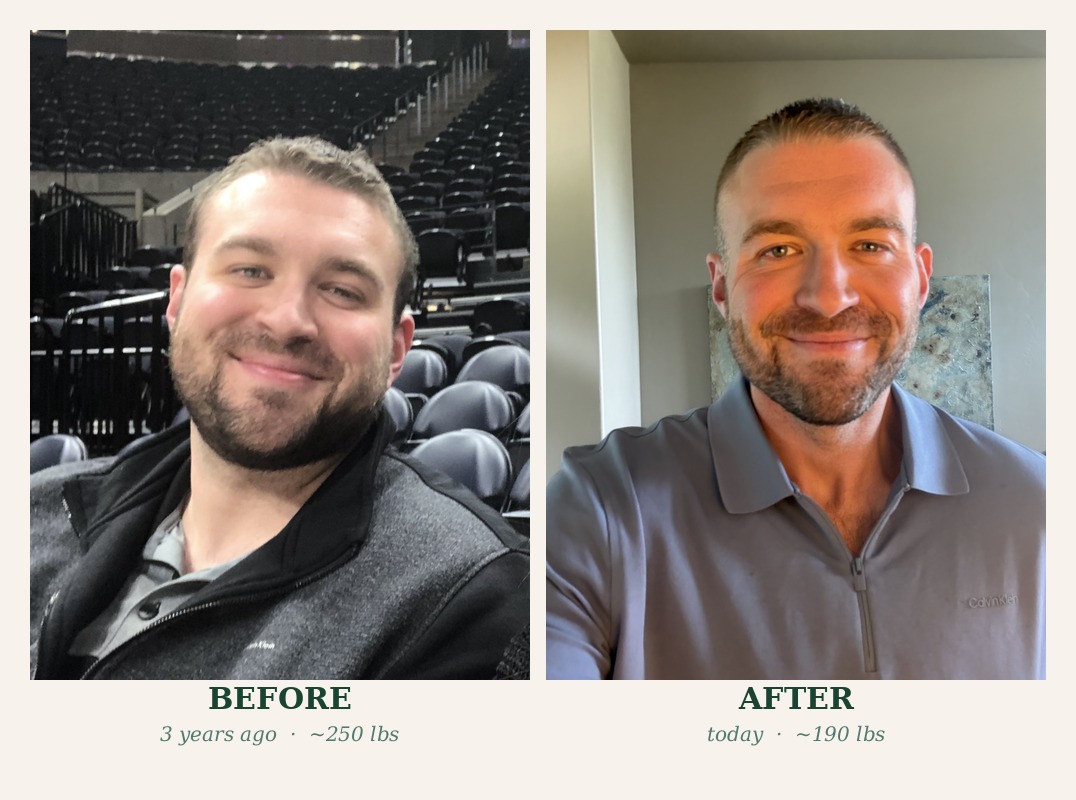
I just finished reading a piece over at Levels called “Why You Can’t Exercise Your Way to Weight Loss,” and I had to sit down and write this immediately. They nailed something it took me decades of trial and error to figure out on my own, and I want to expand on it with what I’ve personally lived through.
A Word About Levels
If you haven’t come across them yet, Levels is a metabolic health platform that I genuinely love. It pulls food logging, sleep, movement, lab work, and (optionally) continuous glucose monitoring into one beautifully designed app so you can actually see how your daily choices are shaping your body. You don’t have to wear a sensor to use it, though I did wear their CGM for six straight months and it was one of the most educational experiences of my life. I was never diabetic, but I was sliding into prediabetic territory, and I wanted to understand what was actually happening inside my body.
Over those six months, I saw in real time which foods spiked my glucose and which ones kept me steady. I learned exactly how long I needed to walk after a meal to blunt a spike, how many hours before bed I needed to stop eating, and what stress did to my numbers (sometimes as dramatically as a bowl of pasta). That feedback loop was vital for getting my glucose into a healthy range, losing nearly 100 pounds, and pulling my body back into homeostasis.
What Metabolic Health Actually Means (and why it’s the whole game)
Only about 12% of American adults are considered metabolically healthy. The other 88% are sitting somewhere on a spectrum of dysfunction, often without knowing it, often while their doctor tells them they’re “fine.”
So what is metabolic health? It’s a measure of how efficiently your body turns food into usable energy, and it shows up in markers like fasting glucose, fasting insulin, triglycerides, HDL cholesterol, blood pressure, waist circumference, and inflammation. When those numbers are in a healthy range, your body is built to burn fat, regulate hunger, stabilize mood, support your brain, and lower your risk of chronic disease. When they’re out of range, your body is stuck in storage mode, and no amount of willpower at the gym will override the biology.
Glucose is the most visible, trackable signal in that system. It’s the window you can open in real time. But metabolic health is the bigger picture behind the window.
Two people, the same meal
Your metabolic response to food is deeply individual. Two people can eat the exact same meal and have wildly different glucose curves, hormone responses, and energy outcomes. There is no universal “healthy food.” There is only how your body handles a specific food on a specific day under specific conditions.
When I first put on the CGM, I assumed I’d see the obvious offenders spike my glucose. Candy, soda, cookies. And sure, those did what you’d expect. What I did not expect was watching “healthy” foods absolutely crush me. Foods I had been eating for years, genuinely believing I was doing the right thing, were sending my glucose into territory I didn’t know my body was capable of reaching.
For me, personally, some of the “clean” staples in my diet were quietly driving the exact metabolic dysfunction I was fighting to fix. And without the data, I would have kept eating them. Forever. Still blaming my slow metabolism, my age, my genes, my luck.
Your list will be completely different from mine. That is the entire point. Until you can actually see how your body responds, you are guessing. Dieting while guessing is brutal, and it’s why so many people work so hard for so little.
The Doman family has known the importance of individuality and looking at the full picture for years. It is the foundation of our work at NACD, and it applies just as much to adult health as it does to child development. Your body is not an average. It is yours.
Sleep and Stress Are Doing More Than You Think
Food was only part of it. The rest was what my body was doing when I wasn’t eating.
On stressful work afternoons, back-to-back calls, deadlines piling up, a difficult conversation at 3pm, I’d glance at my glucose chart and see a curve that looked like I had just eaten pizza and ice cream. Except I hadn’t eaten anything. Nothing had touched my lips. My body was dumping sugar into my bloodstream to fuel a “threat” that was really just my calendar.
That one pattern reset how I think about weight loss.
Here’s the sequence. Stress spikes cortisol. Cortisol tells your liver to release stored glucose into your bloodstream so you have fuel to fight or flee. Insulin rises in response, because insulin’s job is to deal with whatever glucose is circulating. And now you are sitting in the same fat-storing, fat-locking hormonal state as if you had eaten a big meal, just without the nourishment.
Poor sleep does the same thing from a different angle. Even a single night of short sleep can drop your insulin sensitivity by 20 to 30%. Now every meal the next day hits you harder. Cravings for sugar and simple carbs shoot up. Willpower goes down. Your body screams for quick energy and you give in, and the cycle compounds on itself day after day.
If you are not sleeping 7+ hours, if your evenings are screens until midnight, if your nervous system is stuck in low-grade emergency mode all day, your body will refuse to let go of weight no matter how clean you eat or how hard you train. This is biology, not laziness. Your body is trying to protect you from a famine that isn’t actually coming.
The fixes aren’t glamorous. Earlier bedtimes. Walks instead of doomscrolling. Breathwork. Morning sunlight. Real conversations instead of bottled-up frustration. Saying no more often. The unglamorous basics, done with consistency, tracked so you can see the difference they make.
When I finally got my sleep and stress dialed in, my weight started moving in ways diet alone had never produced. You cannot out-diet a broken nervous system.
The Exercise Myth That Derails So Many People
Here is where I think most people get weight loss wrong, and it’s what helped me lose nearly 100 pounds over the last few years.
I’ve been overweight since I was a teenager. Trying to lose weight has been a daily thing for me since before I could drive a car. I’ve tried everything. I’ve watched friends, family, colleagues, strangers at the gym, and myself try everything. And the single biggest mistake I see, over and over again, is putting exercise at the top of the priority list when you have a significant amount of weight to lose.
Exercise is wonderful. It does incredible things for your heart, your brain, your bones, your mood, your longevity. I love exercise. But when you’re carrying 30, 50, 100 extra pounds, hammering yourself in the gym can actively derail you. And the science on why is genuinely fascinating. The Levels article lays a lot of it out, and it lines up with what I’ve lived through and watched play out my whole adult life.
Here are the three big reasons exercise is not the lever you think it is.
1. Your body compensates. It always compensates.
Evolutionary anthropologist Herman Pontzer has done some of the most eye-opening research on this. His landmark study of the Hadza people of Tanzania, a hunter-gatherer tribe that walks 5 to 10 miles a day just to find food, found that they burn roughly the same number of daily calories as sedentary office workers in New York. Same body size. Same total energy expenditure. The Hadza don’t burn more. Their bodies simply shift energy around to keep daily output within a narrow genetic band, dialing down things like inflammation, reproduction, and background metabolism to make room for the movement.
Pontzer calls this the Constrained Energy Expenditure Model, and once you understand it, a lot of gym frustration starts to make sense. The research now suggests the average person who adds a regular exercise routine can expect to lose about 2 kilograms (roughly 5 pounds) over an entire year from exercise alone. One year. Five pounds. That is not a viable weight loss strategy for someone with 50 or 70 pounds to drop.
2. Exercise makes you hungrier.
Hard workouts often ramp up appetite. Post-workout hunger can wipe out the deficit you just created, often with interest. You “earn” a meal, you eat 1.5x what you burned, and the math never works. This pattern shows up often in the exercise and weight loss literature, and it’s one quiet reason so many people plateau for years doing hours of cardio a week.
3. The insulin piece is the real story.
This is where the Levels perspective gets really useful. Weight loss is not just a calorie equation. It’s a hormonal one.
When your glucose is spiking and crashing all day, your insulin stays elevated. High insulin makes it much harder to release fat from fat cells. You cannot efficiently burn fat when insulin is high, no matter how many calories you burn on the treadmill. Over time, chronically high insulin leads to insulin resistance, which leads to even higher insulin, which leads to leptin resistance (so your brain never gets the “I’m full” signal), which leads to a stubborn weight-gain cycle that exercise alone simply cannot break.
The leverage point is not the treadmill. It is your metabolism. Stabilize your glucose, lower your baseline insulin, and you flip the switch from fat storage to fat burning.
What Actually Moves the Needle
When someone has real weight to lose, I tell them to put 99% of their focus on diet. Not on hitting PRs. Not on training for a 5K. Not on finding the perfect workout split. Just on what’s going into their mouth and when.
And here’s the formula I’ve personally seen work, including on my own body:
That’s the core. Dial in your food, walk a lot (especially after meals, which is one of the single best glucose-lowering tools on the planet and backed hard by the research), and every so often, do a water fast long enough to flip on autophagy.
Autophagy is the cellular cleanup mode your body enters when it’s not busy processing food. It helps clear out damaged cells, and it may help signal to your system that it’s safe to release fat. A well-timed fast can be a useful tool for someone whose body has forgotten how to let go of weight. Fasting tells your body, quite literally, that it’s okay to release what it’s been holding onto.
The practical piece matters. Autophagy does not kick in at the 12-hour mark or the 14-hour mark. It generally takes 18 hours or more of no food, yes, only water, before cellular autophagy ramps up. That is why an overnight fast is great for a lot of things but not for this specific lever. If you want the autophagy benefit, you have to go long enough to actually get there.
For many healthy adults, a reasonable starting point is a 24-hour water fast, 7pm to 7pm (check with your physician first). Finish dinner tonight at 7pm, drink water (and black coffee or plain tea if you need it) until 7pm tomorrow, then eat a normal dinner. One meal skipped. Two, if you count lunch. That is it. See how you feel after. For most people the first one is the hardest and the second one feels almost easy. That is your body remembering how to do something it is genuinely built for.
The vast majority of my nearly 100 pounds came off this way. Diet dialed in. Long daily walks. Periodic fasts to unlock autophagy and remind my body that it was safe to let go. No marathon training. No CrossFit boxes. Just the boring, foundational stuff done with consistency.
Then, And Only Then, You Ramp Up Exercise
Once you’ve dropped the bulk of the weight and your body is operating from a healthier baseline, that’s when you go after exercise hard. Because now exercise is no longer fighting you. It is amplifying everything you’ve already built.
This is where you go from good to great.
Strength training reshapes your body, protects your bones, cranks up your metabolic rate, and makes you feel like a completely different human being. Cardio sharpens your cardiovascular system, builds endurance, and does things for your brain that few pills or supplements can match. You’ll keep losing fat. You’ll finally start putting on muscle. Your body composition will change in ways the scale can’t even capture.
And I want to say this as plainly as I can: exercise is good for your mental health. The difference in my anxiety, my mood, my sleep, and my clarity between a sedentary week and an active week is not subtle. It is staggering. Once your body can handle it, exercise becomes one of the most effective mood and stress tools there is. If you are struggling with depression or anxiety, talk with a professional too.