
I decided to go strict clean keto because of a phrase I use on myself a lot when things feel hard.
Zoom out.
Would I rather eat keto, or have chemo later? Would I rather skip the bread, or have my tongue and teeth taken out of my face if the cancer comes back? Would I rather do a water fast, or sit through radiation on my face?
Framed that way, a clean plate stopped being a sacrifice. It became the easy choice. The no-brainer choice.
If you read Part 1 of this article, you already know the philosophy. The goal is metabolic health. The weight loss is a side effect. Food is fuel and food is medicine, and the engine underneath the scale is what we’re actually building.
This is the playbook. What I ate. Why. And how my diet has changed as my body has changed.
The two camps, and why it’s fifty-fifty
There are two honest ways to change your diet.
One camp goes all-in on day one. Rip the bandaid. Clean house. No ramp. The other camp eases in. One thing at a time. Build the habit. Compound the wins.
I’ve watched both work. I’ve watched both fail. From everything I’ve seen in myself and in the people I’ve talked to about this, it really is fifty-fifty which approach sticks. The all-in people burn the ships on purpose because the middle ground kills them. The ease-in people burn out on restriction and only hold gains they built gradually. Neither camp is right. Both are right for somebody.
Figure out which one you are before you start. If you’ve tried going all-in four times and quit after a weekend every time, you’re probably not the all-in type, no matter how much you want to be. That’s useful information.
I’m the first type. When I’m serious about something, I go all the way. Halfway is worse than not starting for me. I had cancer to fight, I had a family and two little kids to stay healthy for, and I had a body that hadn’t responded to anything less extreme. So I went all in.
What clean keto actually means
Keto has an image problem.
If you spend any time on the internet, you’ll see people eating a pound of bacon for breakfast, a stick of butter in their coffee, heavy cream on everything, three cheese sticks as a snack, and calling it keto. Technically, the macros check out. They’re in ketosis. But that’s not the kind of keto I’m talking about, and it’s not the kind of keto that heals anything.
Clean keto means whole foods. Grass-fed and pastured protein. Real fat from avocados, olive oil, butter, and the animal itself. Low-starch vegetables with actual colors and textures and water content. Very little from a bag, a box, or a factory. No “keto-friendly” snacks engineered in a lab. No artificial sweeteners. (Allulose and stevia are okay in small amounts.) No seed oils. No “just this once.”
If it grew or it grazed, it’s probably okay. If it was manufactured to hit a macro target, it’s probably not.
I wrote an eleven-page protocol for myself before I started, so I wouldn’t be standing in my kitchen at 6pm making decisions I was too tired to make well. It covers what I eat, what I don’t, why, and how I adjust around workouts and fasting. That protocol is the reason I lasted three months without a single break.
It’s also why I’m still on a version of it today. What started as a strict three-month attack has gradually become how I eat, period. The decisions I systematized then are decisions I don’t have to make anymore. They’ve turned into defaults. That’s what real change looks like when it sticks. Not white-knuckled discipline forever. A new normal.
What ketosis actually is, in plain language
Your body has two main fuels. Glucose, which comes from carbs and sugar. And fat, which your body either eats from your plate or burns off your own reserves.
Most people run on glucose their entire lives. Every meal spikes it. Insulin comes out to clean it up. Whatever doesn’t get used right away gets stored. And while insulin is high, your body can’t reach into its fat stores for fuel. The door is locked.
Ketosis is when you eat so few carbs that your body finally runs out of glucose and switches to burning fat as its primary fuel. It breaks fat down into molecules called ketones, and your brain and body run on those instead. It’s the same system your body uses during a fast. Your ancestors spent a lot of their lives in it. Your body knows exactly how to do it. You just haven’t asked it to in a long time.
When you’re in ketosis, your insulin stays low, which unlocks the door to your fat stores. Your glucose stays steady, which quiets the cravings and energy crashes. Your brain, weirdly, gets clearer. Most people report better focus, steadier mood, and way less food noise the week after they fully adapt.
Getting there takes about three to ten days of strict low-carb eating. The first few days are rough for most people. Headaches, low energy, brain fog, irritability. The internet calls it the “keto flu.” It’s real, it’s temporary, and it’s mostly a sign that your body is burning through its last glucose stores and making the switch. Electrolytes help a lot. Salt, magnesium, potassium. Push through it and the other side is worth it.
Food noise, and what hunger actually feels like
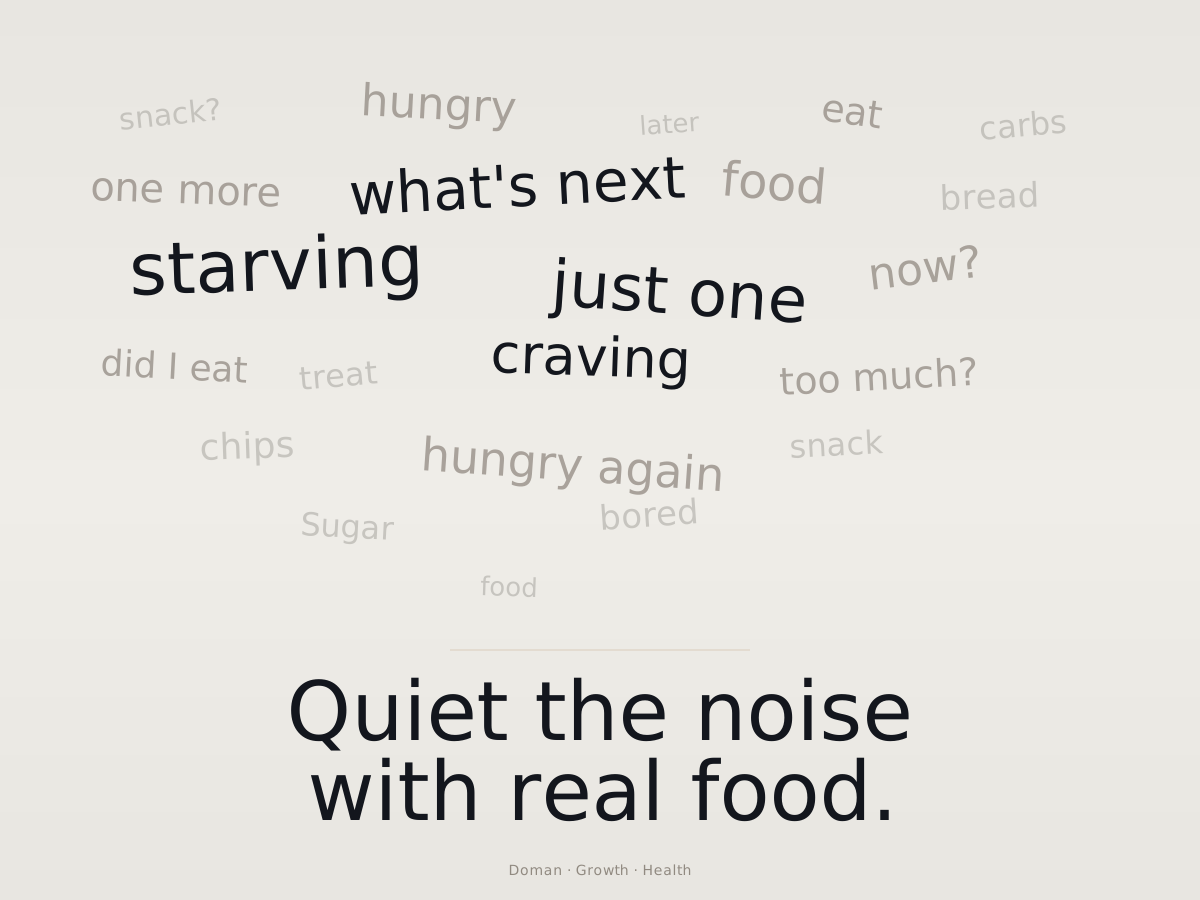
Ketosis does something a lot of people don’t expect. It quiets food noise.
Food noise is the constant, chattering internal monologue about eating. Should I have a snack? What’s for dinner? Is there something in the fridge? Am I hungry? Could I be hungry? Most people live with that voice running in the background all day and don’t know it’s there until it stops.
I didn’t know how loud mine was until my first real water fast.
The first twenty-four hours of a water fast is noisy. Your hand reaches for the fridge out of muscle memory. But somewhere around thirty-six or forty-eight hours, something strange happens. The noise goes quiet. And in that quiet, you realize most of what you were calling “hunger” wasn’t hunger at all. It was craving. Boredom. Habit. Dehydration. Your hypothalamus uses overlapping signals for thirst and hunger, so when you’re low on water your brain often tells you to eat.
Real hunger is quiet. It’s clean. It feels nothing like the chatter most of us walk around calling an appetite.
This is also, not coincidentally, what people describe when they go on a GLP-1 medication. Semaglutide, tirzepatide, retatrutide. The weight loss is real. But patient after patient says the same thing: the food noise stopped. For people who’ve spent decades cycling through diets and emotional eating, the silence is the story. We’ll go deeper on GLP-1s and peptides when we get to Step 07 in this series. For now, just know that your own body is capable of the same quiet, without a prescription, if you give it enough time to remember how.
My food rules at the highest level
This is the shortest, cleanest version of how I eat.
- Protein anchors every meal
- Fat to satiety, never forced
- Vegetables above the ground, not below
- No sugar, no grains, no alcohol
- No sugar substitutes, not even the “healthy” ones
- Two intentional meals, no grazing
- Treats are planned, never reactive
- Glucose data settles every argument
Eight lines. The eleven-page protocol lives underneath them, but if someone put a microphone in front of me and asked how I eat, those eight would be my answer.
The phases
The diet that works when you’re fifty pounds overweight and metabolically broken is not the diet that works when you’re fifteen pounds from your goal. And the diet that gets you to your goal is not the diet that keeps you there, or the diet that turns good into great. Most people find an approach that works in one phase and try to live on it forever. It doesn’t work. Not because the diet was wrong, but because the phase changed and they didn’t.
There are three phases in my own journey.
Phase 1. Attack.
Strict clean keto. Glucose on the floor. Ketones up. Insulin low. Body burning fat as its primary fuel. This is where I dropped thirty pounds in three months.
The goal of this phase is to break the metabolic pattern and prove to your own body that it still remembers how to burn fat. It’s not a forever diet. It’s a reset. A statement. A period of total clarity where you prove to yourself that the machine still works when you stop jamming it with fuel it wasn’t built for. Anyone who tells you clean keto is a lifelong plan is missing the point.
Attack is short and intense by design. Three months was right for me. Two might be right for someone else. Six might be right for someone who’s been metabolically stuck for decades. The point is that it has an end, and you know what the end looks like before you start.
Phase 2. Stabilize.
Low-carb but out of strict ketosis. This is where I am right now.
I’ve added back a little more variety. Fermented foods for the gut. Healthier dairy in moderation, like A2 organic yogurt. The guardrails from Phase 1 stay in place. No sugar, no grains, no alcohol, no seed oils, no sugar substitutes. But the day-to-day feels more like a life and less like an intervention.
The goal of this phase is sustainability. I want a way of eating I can do for years, not months. Attack was a tool. Stabilize is a life. If I stayed in attack forever I’d eventually break, and when I broke I’d break hard. I’ve seen it happen to too many people. Stabilize is what keeps the work from coming undone.
Phase 3. Perform.
This one is coming, not here yet. When I’m at my goal weight and holding it steady, I’ll start adding strategic carbs around hard training. Sweet potato. White rice occasionally. Real fruit. Real honey. Carbs that fuel work, not carbs that spike me for no reason.
The focus shifts from fat loss to body composition and real performance. Muscle. Output. Recovery. The metabolic foundation I built in Phase 1 and Phase 2 is what makes Phase 3 possible. You can’t skip to performance. You earn your way into it by building the engine first.
What breaks most people
The mistake almost everyone makes is treating one phase as the whole picture.
Some people go too strict for too long and burn out. They were in attack mode for a year when they needed to transition to stabilize at month four. Their body adapted. Their willpower ran out. They quit and rebounded.
Other people never go strict enough to break the pattern in the first place. They try to stabilize a problem that hasn’t been attacked yet. They eat “mostly healthy” for years, never get into ketosis, never reset their insulin, and wonder why the scale won’t move.
And a lot of people hit their goal weight on an intervention diet and then drift right back to the eating that broke them, because they never built the stabilize version of their life. The weight comes back because they never practiced the maintenance version of the plan.
Closing
This is a lot. I know it is. I’ve been living inside this stuff for years, and it took me a long time to sort out the difference between attack and stabilize, between clean keto and the lab version of it, between real hunger and food noise.
If you only take one thing from this article, take the phase idea. You don’t eat the same way forever. Your body changes. Your needs change. Your life changes. The diet that saves you at thirty pounds overweight is not the diet that keeps you strong at your goal weight.
Figure out which phase you’re actually in. Eat for that phase. Change the plan when your body is ready for the next one.
Food is fuel. Food is medicine. And the right dose of the right food at the right time is how you heal.
What’s next in the series
Step 01 is done. Here’s what comes next.
- The Meal Is Only Half the Story · Step 02 Now live. The dozens of tiny decisions around every meal that decide whether food becomes fuel or storage.
- Step 03. Sleep & Stress The half of weight loss that has nothing to do with what’s on your plate.
- Step 04. Walking The single most underrated tool for blunting glucose spikes, building endurance, and unlocking weight loss.
Catch up on Step 01. Part 1, Food Is Fuel. Food Is Medicine. · The series opener, Why You Can’t Exercise Your Way to Weight Loss.
Get the rest of the series.
Step 02, Step 03, and the rest. I’ll email you when each new piece drops. No spam, no funnel.
Want personalized coaching?
If you’d like tailored guidance for your own transformation (metabolic, nutritional, behavioral), reach out about Doman Health coaching.
Learn MoreThis article is personal experience and general wellness content. It is not medical advice. Consult your physician before starting fasting protocols, significant dietary changes, ketogenic diets, or supplementation, especially if you are managing a medical condition, pregnant, or taking prescription medication.